The workplace is not what it used to be. Over the last few years, artificial intelligence has moved from being a futuristic concept to a daily productivity partner. Much of this shift has been accelerated by breakthroughs from OpenAI, the organization behind tools that millions of people now use for writing, coding, research, design, and automation.
But the real question is not just about AI tools. The bigger question is: What does the future of work look like after OpenAI innovations?
In this detailed blog, we will explore how jobs are changing, what skills will matter most, how businesses are adapting, and how you can prepare yourself for the AI-powered future.
Introduction: The AI Turning Point
For decades, technology changed work gradually. Computers replaced typewriters. Email replaced letters. Smartphones replaced desk phones.
However, AI tools powered by advanced language models have changed work at a much faster speed. Platforms built by OpenAI introduced conversational AI that can:
- Write reports
- Generate code
- Analyze data
- Create marketing content
- Assist in research
- Automate repetitive tasks
This shift is not just digital transformation. It is intelligence transformation.
The future of work after OpenAI innovations is not about humans vs machines. It is about humans working with AI.
How OpenAI Innovations Are Reshaping Jobs
OpenAI’s models have influenced almost every industry. Let’s understand how.
1. Content and Marketing
AI can now:
- Draft blog posts
- Create ad copies
- Generate email campaigns
- Suggest SEO keywords
Marketing teams are no longer spending hours brainstorming basic content. Instead, they are focusing on strategy, creativity, and storytelling.
Impact:
Content creators who learn to use AI become faster and more productive. Those who ignore it risk falling behind.
2. Software Development
AI coding assistants help developers:
- Write code snippets
- Fix bugs
- Explain complex logic
- Suggest optimizations
This does not eliminate developers. It makes them more efficient.
Future trend: Developers who understand AI-assisted coding will dominate the tech industry.
3. Customer Support
AI chatbots are now capable of handling:
- FAQs
- Complaint resolutions
- Order tracking
- Basic troubleshooting
Companies reduce response time and improve customer satisfaction.
However, complex emotional issues still require human touch.
4. Data Analysis
AI tools can:
- Summarize datasets
- Create reports
- Identify patterns
- Generate visual insights
This reduces the need for manual analysis and increases decision-making speed.
The Rise of AI-Augmented Professionals
The future of work after OpenAI innovations is not about job loss. It is about job evolution.
We are entering the era of AI-augmented professionals.
These professionals:
- Use AI as a co-worker
- Automate repetitive tasks
- Focus on high-value thinking
- Deliver faster results
For example:
- A writer becomes an AI editor + strategist
- A teacher becomes an AI curriculum designer
- A marketer becomes an AI campaign optimizer
AI becomes the assistant. Humans remain the decision-makers.
New Jobs Created by AI
Every technological revolution creates new roles. OpenAI innovations are no different.
Emerging Roles in 2026 and Beyond
- AI Prompt Engineer
- AI Workflow Designer
- AI Ethics Consultant
- AI Content Strategist
- Automation Specialist
- AI Product Trainer
- AI Compliance Officer
Companies need professionals who understand how to integrate AI into business processes responsibly and effectively.
Skills That Will Matter Most
To survive and grow in the future of work after OpenAI innovations, focus on these skills:
1. Critical Thinking
AI can generate information. Humans must evaluate it.
2. Creativity
AI can assist creativity but cannot replace original thinking.
3. Emotional Intelligence
Leadership, empathy, negotiation, and communication remain human strengths.
4. AI Literacy
Understanding how AI works and how to use it responsibly will become essential.
5. Adaptability
The biggest skill of the future is the ability to learn continuously.
Remote Work and Global Opportunities
OpenAI-powered tools enable:
- Real-time communication
- Automated documentation
- Global collaboration
This strengthens remote work culture.
Companies now hire based on skill rather than location. Freelancers and remote workers benefit the most.
Challenges of AI in the Workplace
While the future looks promising, challenges exist.
1. Job Displacement Fear
Some repetitive roles may decline. Workers must reskill.
2. Data Privacy
AI tools require data. Businesses must protect sensitive information.
3. Ethical Concerns
Bias, misinformation, and misuse are real concerns.
4. Overdependence on AI
Blindly trusting AI without human review can create errors.
Balanced integration is the key.
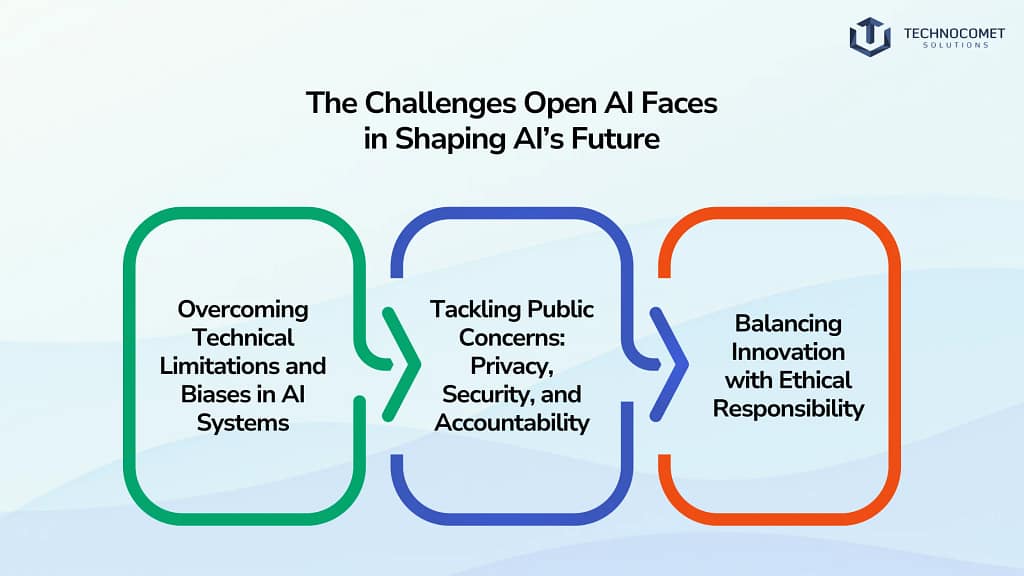
How Businesses Are Adapting
Forward-thinking companies are:
- Training employees in AI tools
- Creating AI usage policies
- Investing in automation
- Encouraging innovation culture
Rather than replacing employees, smart businesses are upgrading them.
Education and AI
The education system is also evolving.
Students now use AI for:
- Learning assistance
- Research support
- Coding help
- Language improvement
Future workers will grow up with AI as a normal tool, just like the internet.
The Human Advantage in the AI Era
Despite all innovations, some things remain uniquely human:
- Vision and purpose
- Moral judgment
- Deep empathy
- Complex leadership
- Cultural understanding
The future of work after OpenAI innovations depends on combining human intelligence + artificial intelligence.
Practical Steps to Prepare for the AI Future
If you want to stay ahead, start today:
- Learn one AI tool deeply
- Automate one daily task
- Improve your communication skills
- Build problem-solving ability
- Create a digital portfolio
- Stay updated with AI trends
- Focus on value creation
Small steps today will create big opportunities tomorrow.
Conclusion
The future of work after OpenAI innovations is not a threat. It is a transformation.
AI is not here to replace humans. It is here to enhance human potential.
The professionals who will succeed are those who:
- Embrace AI
- Upgrade their skills
- Think creatively
- Lead ethically
We are not entering a world where machines dominate.
We are entering a world where humans who understand AI dominate.
The future belongs to the adaptive.
FAQs
1. Will AI replace most jobs?
No. AI will automate repetitive tasks but will also create new opportunities.
2. What industries will benefit the most from OpenAI innovations?
Technology, marketing, education, healthcare, finance, and customer service.
3. Is coding still a good career choice?
Yes. AI-assisted coding increases productivity and demand for skilled developers.
4. How can students prepare for AI-driven jobs?
Learn AI tools, improve critical thinking, and build digital skills.
5. Is AI safe to use at work?
Yes, if companies follow ethical guidelines and data protection practices.
6. What is the most important future skill?
Adaptability and AI literacy.
7. Can small businesses benefit from AI?
Absolutely. AI reduces cost, increases efficiency, and improves productivit